Showing posts with label Gesellschaftliche Aspekte der Informationstechnologie. Show all posts

Wednesday, March 31, 2021

"Sicher"heitsfragen, Teil 4

Heute lässt ebay grüßen:

Rot: Öffentliche Information, wenn man ein Facebook-Profil hat.

Orange: Möglicherweise öffentliche Information, sonst relativ leichte Dictionary-Abfrage. (Wieviele Schauspieler und Fernsehserien gibt es schon auf der Welt?)

Gelb: Okay, darüber redet man in unserer heutigen Gesellschaft möglicherweise nicht mehr viel miteinander.

Grün: Die einzig sinnvolle Option.


Darüber hinaus: "Bei Antworten können Sie Groß- und Kleinschreibung außer Acht lassen, sie dürfen keine Symbole enthalten und sollen sich nicht häufig ändern." Muss ich meiner Trauzeugin jetzt sagen, dass sie bitte nicht allzu oft eine Namensänderung durchführen darf? Soll ich aufhören, meine Partner und besten Freunde durchzuwechseln? Was, wenn mein Filmgeschmack sich ändert?

Sunday, January 20, 2019

"Sicher"heitsfragen, Teil 3

Aller schlechten Dinge sind drei:


Da hätte man genausogut fragen können "Was sind die dritt- und viertletzte Ziffer der Telefonnummer?". Sprich, es gibt nur 100 Möglichkeiten.

Sieht man einmal ganz davon ab, dass meine Nummer im Telefonbuch steht.

Saturday, December 29, 2018

"Sicher"heitsfragen, Teil 2

Ich aktualisiere gerade alle meine Passwörter auf dutzenden Seiten, und es ist eine wahre Fundgrube für wenig intelligente Sicherheitsfragen:


Gängige Fahrzeugfarben lassen sich an einer Hand abzählen, und den Rest würde man über mein Facebook-Profil ganz problemlos herausfinden, würde ich ein solches aktiv führen. Liste der Grundschulen in der Nähe meines Wohnortes ist darüber hinaus auch sehr endlich.

Friday, December 28, 2018

"Sicher"heitsfragen

Wieder einmal eine Seite, die sich durch ganz besonders intelligente Sicherheitsfragen auszeichnet:


Mein Geburtsort ist mein aktueller Wohnort, Vornamen beider Eltern findet man über herold.at heraus, mein erster Dienstgeber (Praktika nicht mitgerechnet) ist mein aktueller Dienstgeber, und meine Schuhgröße ist eine ganze Zahl zwischen 36 und 40.

Thursday, May 19, 2011

Linux vs. Windows (part 2)


-- Birgit

Tux logo courtesy of Wikimedia Commons and authors Larry Ewing, Simon Budig, Anja Gerwinski: http://en.wikipedia.org/wiki/File:Tux.svg

Windows logo used in accordance with fair use regulations.

Tuesday, April 26, 2011

Linux vs. Windows (part 1)

2001: Dear Linux, you might be a decent operating system, but holy shit do take a look at Windows to see how to build a proper user interface.

2011: Dear Windows 7, you might be a decent operating system, but holy shit do take a look at Linux Mint to see how to build a proper user interface.

Monday, February 21, 2011

Proudly Presenting: Serene Logician

Over the last years, I've spent quite some time thinking about security and, in particular, social engineering. It's something that fascinates me for the same reasons that I like mathematics and stage magic: All those things are about finding missing links in an alleged chain of evidence.

In mathematics, a missing link in a chain of evidence simply means that a proof is incomplete.

In stage magic, a missing link is what allows a magician to produce an illusion of actual magic, by demonstrating to the audience in 20 ways how he has no chance of manipulating something -- while he manipulates it in the 21st way. Indeed, stage magic is often just about providing so much proof that the audience doesn't notice any more that the chain of proof still didn't go from one end to the other. (Rest assured that whenever a stage magician says "Now I put this here so that you can make sure that I don't exchange it", he has already exchanged it long ago. And then proceeds to demonstrate in spectacular ways how he really does not exchange it again.)

What a social engineer does is not much different, and again, the crux is that somewhere in the chain of evidence there must be a missing link. Just think of a fake plumber in front of your door who can show you an ID with his photo and the name of "his" company. You can verify that the photo and his face match. You can verify that the name and his name tag match. You can verify that the hologram on the ID card is real. You can verify that the company exists. You can verify that the phone number on the ID card matches the real phone number of the company. You can phone the company and verify that they have an employee of that name. Maybe they can even confirm that he is supposed to come to you today. And still that man in front of your door has never ever worked for that company. Where's the missing link?

Anyways, I have a thing for finding such missing links, and obviously also a certain skill for it. And given that I'm planning to write about those more frequently now, I've decided to dedicate a blog to them.

Proudly presenting:

You can expect some presenting of basic principles, and a lot of ranting about the daily security lunacies. Posting frequency will vary and I'm not committing myself to any schedule, but there are some postings already in planning, and from experience I run across a post-worthy example every few weeks.

I'd also like to express my sincere apologies to those of you who are already reading my other blogs (plural) for adding another one to the list. On the upside, it's a public one so you can just add it to Google Reader and don't have to open yet another tab for it.

-- Birgit

P.S.: The missing link is the ID card. There's no way to prove that it's genuine, since you most probably have no idea how an ID card of that company is supposed to look like.

The company's confirmation that this employee is really scheduled to visit you can be achieved by calling the company beforehand, pretending to be you (i.e., the visited person) and really requesting the real employee of that name to come to you. When this appointment is then canceled last-minute, chances are high that the secretary at the company isn't notified about the cancellation yet when you call her, and will confirm the appointment.

Friday, February 18, 2011

A cheer to freeware


Every time I re-setup my computer I realize that more and more freeware is running on it. In former times, setting up a computer meant inserting 20 CD-ROMs one after another -- MS Windows, MS Word, MS Office, Paint Shop Pro, ... --, today setting up means to me: First installing Windows, then downloading the most recent versions of all other programs.

Therefore, a cheer to freeware -- which by the way is according to certain sources in the USA a very communist construct ;) --, thanks to which I by now use hardly any proprietary software any more except for Windows.

Here's a list of great freeware programs (or in some cases shareware or demo versions) that are usually installed on my computers:


Basics:
Acrobat Reader / Foxit Reader
Reading .pdf files

GhostView / GhostScript
Reading .ps files

PDF24 Creator
Creating and editing of .pdf files

pdf995
Creating .pdf files by a printer driver

TortoiseSVN
Version control with SVN

CDBurnerXP
Burning CDs and DVDs

7-Zip
File compression program for (almost) all formats

cygwin
Linux emulator

DOSBox
DOS emulator


Creating and editing of documents:
nodepad++
Text editor and source code editor

LibreOffice
Office programs: Text editing, spreadsheet processing, presentations, ...

MikTeX
Compilation of LaTeX documents

WinShell
LaTeX editor

Asymptote
Programming language and compiler for creation of vector graphics

GeoGebra / Euklid DynaGeo
Creation and editing of interactive geometry sketches


Programming:
eclipse
Development environment

Java JDK
Java (development kit and Virtual Machine)

Visual C++ Express
C++ (development environment and compiler)

Python
Python

SWI Prolog
Prolog (development environment and compiler)


Graphics:
IrfanView
Display of image files

Gimp
Image editing

Paint.net
Image editing

Inkscape
Editor for vector graphics

autostitch
Assembling large images from multiple photos (image stitching)


Music and multimedia:
iTunes
Music playback, download and playback of podcasts, managing of files on an iPod

VLC Media Player
Playback of videos and DVDs

Winamp
Music playback

Amarok
Music playback

VirtualDub
Video recording and editing

NoteWorthy Composer (Demo)
Creation of sheets of music


Internet:
Firefox
Browser

Chrome
Browser

Thunderbird
Email and newsgroup client

IMAPSize
Backup of IMAP email accounts

PuTTY
SSH and Telnet client

WinSCP
FTP and SFTP client with GUI

pidgin / qip
Instant messenger (for ICQ, AIM, ...)

ChatZilla
IRC client

Skype
Skype client (for internet telephony)

Apache
Webserver (for local testing of homepages)

Vuze
client for peer-to-peer filesharing


Antivirus:
Avira AntiVir
Anti-virus software

Spybot
Anti-spyware program


Datenbanken:
MySQL
MySQL data base system

NaviCat Lite
GUI for MySQL


lG Birgit


Edit (2011-02-18): Add Foxit Reader and PDF24 Creator.

Edit (2011-02-24): Update OpenOffice.org to LibreOffice.

Tuesday, November 23, 2010

The Mobile Internet Provider
A tragedy in five parts

Part 1: The UMTS-USB-Stick

Dear Mobile Internet Provider,

Thanks for sending me my new UMTS-USB-Stick! Since I assume you will appreciate user feedback, may I suggest that you might want to program future versions of the stick in such a way that they can be installed without clicking away no less than 36 -- that's where I stopped counting -- "Install hardware now?" and "This has no Windows Logo test. Really install hardware now?" dialogs? (Hint: 35 is no acceptable number either.)

Best regards,
A user.


Part 2: The user manual

Dear Mobile Internet Provider,

After half an hour of tedious clicking through install messages, I finally managed to properly install the USB stick -- as a USB connection device, a USB mass storage device, another USB mass storage device, a drive, and as a CD-ROM drive. I don't know why your USB stick believes itself to be a CD-ROM drive, but I assume we all have our problems, and I sympathize.

However, I now tried to set the preferences, and since you chose to provide only a bad imitation of a human readable interface, I resorted to reading your documentation and got stuck there. In particular I'm trying to create a new connection profile. Your documentation tells me:
1. Choose "Settings > Options > Profile Management". (Well hidden, I grant you, given it's a function every single goddamn user will have to use, but findable with some clicking.)
2. Click onto "New". (No rocket science. I could have done that.)
3. Set all parameters. (Set to what, pray tell?)
4. Click "OK". (I think I would have figured that one out.)
5. Close the settings window. (That one might have been a tough nut...)

Let me give you my equally helpful suggestion on how to make this documentation somewhat more usable:
1. Start your computer.
2. Enter your username and password, then press Enter.
3. Trash that whole bullshit and rewrite it from scratch.
4. Save the files you edited.
5. Close the editor.

Best regards,
A sceptical user.


Part 3: The user credentials

Dear Mobile Internet Provider,

I am now ready to connect to the internet, and the USB stick demands a PIN. I therefore grabbed the letter with the credentials that you sent me along with the "How to get online immediately" guide. The first line of the letter tells me to go to your homepage, where allegedly I will be able to log in using the credentials you sent me, and receive my PIN.

While I appreciate the Catch-22 reference, I can't help wondering about two things:
a) I need Internet access in order to get Internet access? Srsly?
b) Why do you send me top secret credentials that I can use to retrieve my top secret PIN, instead of just sending me my top secret PIN?

Best regards,
An annoyed user.


Part 4: The PIN

Dear Mobile Internet Provider,

I tried to go to your homepage to in order to log in there, using my top secret username ("my4358625sddfj") and my top secret password ("05051986"). Since I assume nobody has informed you yet, I would like to point out to you that usually the password is supposed to be a random sequence of letters and numbers, whereas the user name should be something easy to remember, such as my birthdate. Not the goddamn other way round.

I shall give you the benefit of the doubt and assume that if someone actually has told you so, you probably could not understand him at that moment because his voice was drowned out by the cries of agony and despair from your homepage user interface testers. Whole legions of usability engineers must have lost faith in humankind upon seeing this masterpiece of pure, unadulterated user hostility, taking their entire families with them in harakiri to spare them life in such a world.

I eventually found the correct login sequence by releasing a bunch of test monkeys onto your page, programmed to randomly click links, enter the provided credentials and scan returned pages for four digit numbers near the phrase "PIN". Shortly after two of the test monkeys spontaneously evolved to sentient AIs (and promptly committed suicide to cleanse themselves from having touched your UI), one of the remaining ones succeeded in retrieving my PIN by accidentally clicking onto what had appeared to be a background element.

Best regards,
A frustrated user.


Part 5: The aftermath

Dear Mobile Internet Provider,

It's been two weeks since my last letter. I still can't connect to the Internet. While my other UMTS-USB-Stick (which unfortunately I can't use for connecting because it is registered in an other country) finds 5 networks of varying but decent signal strength, your UMTS-USB-Stick finds exactly ... none. Not only does it fail to connect, it also fails to cancel trying to connect. Heck, it fails trying to cancel cancelling trying to connect. Interestingly, it does not fail to cancel cancelling cancelling trying to connect, but I assume that is only because it would have required your programmers to understand recursion.

If you as a company really believe in making this world a better place as your advertisement claims, then please go and find whoever programmed this, break every finger they ever used to write code with (though most likely that's only the index fingers), every finger they possibly ever could write code with (and to be on the safe side, also the toes), and for posterity's sake, geld them. I would have suggested forcing them to use their own products, but I'm against undue cruelty.

As far as I am concerned, I'd hereby like to cancel my contract with you at the first possible date.

Best regards,
A former user.


Any similarity to real companies or events is inevitable, but purely coincidental.

-- Birgit

Saturday, October 9, 2010

Collatz Rule

The Collatz Rule (for informatics professors): "Before telling your students about the Collatz Conjecture, make sure you don't need the computer lab for anything else within the next two months."

-- Birgit

Tuesday, October 5, 2010

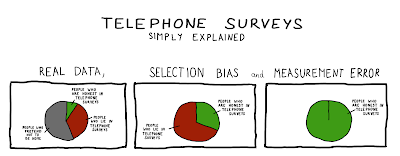
Telephone surveys simply explained


Of course, this simplifies the issue, so let's honor it with a bit more detail.

(Note: I'm neither a specialist on statistics nor on telephone surveys. I'm only applying some common sense here.)

Sources of errors and biases


By and large there are two kinds of errors that can distort survey results:
  • Errors due to parts of the population not being reachable by phone ("selection bias").
  • Errors due to people not answering honestly ("measurement error").


Selection bias

There are various reasons why people can't be reached. Some don't have phones. This includes relatively isolated parts of the population, such as indigenous tribes and Amish people, but also homeless people, children, and people with alternative life styles who don't use phones by choice. Others just don't pick up when they see unknown or suppressed numbers.

Most telephone surveys deal with this by just extrapolating -- that is, hoping that those who could not be reached would have answered similar to those who did pick up. How well this approach works depends largely on how strongly the question is correlated to the reachability. Ideally, there is no correlation at all.

For example, if the question is "Do you prefer strawberry or vanilla ice cream?", then it's quite likely that this is not strongly linked to the possession of a phone. Probably the percentage of homeless who like vanilla better is similar to the percentage amongst millionaires.

Asking "Do you own a phone?", on the other hand, is akin to asking "Are you asleep?". You will not get a [credible] "no" for an answer.

Most questions are somewhere in the grey area between these extremes. For example, "Did you book a holiday on the Internet this year?" has distorted results, because of those people who did, a certain percentage is probably on this very holiday when the survey is being made.

Similarly, political opinion polls are likely to be distorted, because preference for a particular party is strongly tied to the social group -- and so is reachability by phone. A party with a program that favors young educated people for example might underperform in such surveys, because young educated people have mobile phones with caller ID, and know how to put anonymous calls onto an ignore list.

Other kinds of surveys have similar issues with selection bias. For example, a survey that is conducted in a shopping mall by randomly approaching people might not exclude people without phones, but it preselects on "people who go to shopping malls", and additionally has some preselection against assertive people who are more likely to refuse to take part in the survey.

Finally, the real selection bias nightmare are surveys where people can sign up themselves to participate. This is something that many non-profit organizations suffer from. Not having the money for a professional survey, they often send out "Please take our latest survey" emails to friends and mailing list subscribers -- which is a group that's usually very far away from the average opinion on the topic at hand. It's a bit like asking your five best friends if they like you, and then extrapolating that all the world loves you: Good for your self-esteem, but not very realistic.

Measurement error

Measurement errors are simpler to explain: Some people just don't answer honestly or correctly. Again, how much of a problem this is depends on the question. For some questions, people don't have any incentive to lie. Take for example the already mentioned vanilla or strawberry ice cream preference.

There are other questions however where people are much more likely to lie. "Do you cheat on your wife/husband?" is a classical one. But also certain political parties are generally underrated in pre-election polls because people are too embarrassed to admit that they vote for them. For example, we all know that nobody would ever vote for the FPÖ (except for those 10-20% that regularly do so at the elections, but miraculously never show up in any polls).

Besides intentional lying there are also questions where people simply don't know the correct answer. Smokers for example tend to underrate how much money they really spend on cigarettes, and few people can really tell how many hours per day they spend on the Internet or watching TV.

And sometimes people just don't understand the question. Ask enough people whether they have ever seen a phishing attack, and you will find some who have never heard of "phishing" before, hear "fishing" instead, and answer "no" because no, they have never seen a fish attack anyone.

Handling errors and biases


In order to handle these errors and biases, surveys can for example do the following things:

Estimating known biases

In some cases, previous surveys compared to real data can indicate what biases are to expect. For example, by comparing pre-election polls with election results, it's possible to see patterns how real results differ from predictions. Once it is known that the aforementioned FPÖ generally is underestimated in surveys, it is possible to estimate how much the bias distorts the result and try to calculate it away.

Weighting sample to match demographics

As mentioned before, some groups of the population are underrepresented in those samples because they are less likely to be reachable by phone than others. Surveys that also ask for age, gender and similar attributes can weight the answers so that the overall result better matches the distribution in the population. For example, if it is known that 30% of the population are older than 50 years, but of the people who took part in the survey only 10% are, then those 10% get more weight.

Stratified random selection

When proper distribution amongst certain population groups is crucial, instead of randomly calling phone numbers, the survey participants can be selected randomly per group, and if necessary even be surveyed by different means. For example, when it's important to avoid that homeless people are underrepresented -- for example, for a discount store they might be an important group of the customers --, then a survey will randomly select 200 phone numbers, and in addition perform 100 random in-person surveys at a homeless shelter. It will have other selection biases, but can avoid those that are known to be important to a particular survey.

Estimating result confidence


Even if there were no sampling biases and no measurement errors, there would still stay the problem that only a small fraction of the population was asked. So how much can asking 10 people really tell us about the average person?

Let's look at the simple example from above in detail. We want to know whether Austrians prefer strawberry or vanilla ice cream. We randomly choose 10 phone numbers and call them. 1 person likes strawberry and 9 prefer vanilla. To certain news papers this would be enough evidence for saying that 90% of the Austrians prefer vanilla ice cream. But what do we really know? The only thing we know for sure at this point is that 9 of the 8000000 Austrians like vanilla ice cream. Or, more precisely, that 9 Austrians say that they like vanilla ice cream.

The simple truth is that after calling n people, all we know for sure is how these n people answered.

Calling another n could change the whole result. The next 10 people might all like strawberry, and suddenly the preference for vanilla plummets from 90% down to 45%. And this is where probability comes in.

It is, theoretically, possible, that we have accidentally called the only 9 Austrians who like vanilla ice cream. It is possible that all the other 7999991 Austrians hate it, and that the Austrian preference for vanilla ice cream is thus at 0.0001125%. But how likely is it that with only 10 phone calls we really managed to reach these 9? Right. It's about as likely as calling 10 random phone numbers and meeting 9 attractive, single lottery millionaires, which is less likely than winning in the lottery yourself, which is less likely than being struck by lightning.

I will spare you the mathematics, but the most likely explanation for the 9 out of 10 vanilla answers is that 90% of the Austrians prefer vanilla.

Since we only called 10 persons, the result is not very reliable, though. If we call 10000 people and 9000 of them say "vanilla", we would still guess that 90% of the Austrians prefer vanilla, but we would be more confident about our estimate.

Professional surveys will therefore indicate the margin of error, which indicates how reliable the results are, by giving the range within which the real result lies with a high probability, usually 95% or 99%. And here the problems start again, because it's not possible to calculate that range without making even more assumptions. For example, do you assume that any result between 0 and 8000000 Austrians preferring vanilla is equally likely, or do you assume that roughly half of the Austrians preferring vanilla and the other half strawberry is much more likely than nobody liking strawberry?

The truth is that even the estimate can only be estimated. It can be estimated relatively well, though, and it always holds that the larger the sample size, the higher the reliability of the result. So both with 9 out of 10 and with 9000 out of 10000 answers in favor of vanilla ice cream we estimate the real result to be "around" 90%, but with different confidence levels: With 9 out of 10 answers for vanilla, the real result is with a probability of roughly 99% between 50% and 100%. With 9000 out of 10000 answers, it's with a probability of roughly 99% between 88% and 92%.

Conclusion


Surveys can have their uses, but they aren't the absolute truth and should be taken with a grain of salt. At the end of the day, the only thing they tell us for sure is how the people who were called have answered.

-- Birgit

Friday, July 9, 2010

Spot the difference

Exactly one of the employees of the real estate company in the link below is a programmer. Can you spot him?

http://www.deansproperty.com.au/Home/Profiles

kR Birgit

Thursday, July 8, 2010

Award

Und der Award für die dümmste Ausrede, warum man keine Zeit hat Kunden zu beraten, geht an alice.de: Dort gibt es nämlich einen "Live-Chat" mit Servicemitarbeitern, die Fragen beantworten. Bloß, sie sind gerade alle besetzt:

Im Moment befinden sich alle Mitarbeiter im Live-Chat.
Bitte versuchen Sie es gleich noch einmal – wir beraten Sie gerne!

Hat denen schon einmal wer das Prinzip von einem Chat erklärt? *kopfschüttel*

lG Birgit

Sunday, January 31, 2010

Kapiland

Früher hat man in Computerspielen à la Tycoon komplexe Modelle aufgebaut, um die Wirtschaft möglichst realitätsgetreu zu simulieren. Heute ist das viel einfacher: Heute steckt man ein paar tausend Spieler zusammen in ein Online-Spiel mit Marktplatz und wartet ab, was passiert.

Konkret heißt das Ding Kapiland. Jeder Spieler kann Fabriken und Geschäfte bauen sowie durch Forschung die Qualität seiner Produkte steigern. Jedes Produkt benötigt Ausgangsstoffe, die in der Fabrik dann unter gewissen Produktionskosten ins nächste Produkt in der Produktionskette umgewandelt werden.

Einzige Ausnahme hierbei ist Strom: Der entsteht aus dem Nichts. (Vielleicht bestehen die Kraftwerke in Wirklichkeit ja aus großen Ergometer-Farmen, auf denen die Arbeiter dann strampeln, um Strom zu produzieren.) Mit Hilfe von Strom kann man in der Quelle Wasser "erzeugen". Aus Wasser produziert sich Saatgut auf der Plantage. Wasser plus Saatgut ergibt auf der gleichen Plantage Zuckerrohr oder Kakao. Zuckerrohr und Strom wird in der Lebensmittelfabrik zu Zucker verarbeitet. Und zusammen mit dem Kakao wird aus dem Zucker schließlich ein Schokoriegel, der im Lebensmittelgeschäft verkauft wird.

Insgesamt etwa 50 verschiedene Produkte werden in Kapiland so erzeugt und verkauft, von Strom und Wasser über Stahl und Getreide bis hin zu Badelotionen, Cabriolets und Diamantringen. Jedes dieser Zwischenprodukte kann am Marktplatz zwischen den Spielern gehandelt werden.

Und schon fangen die Spieler an, sich zu spezialisieren. Der eine setzt auf Grundstoffe, produziert große Mengen Wasser, Strom und Stahl und erhält sein Geld ausschließlich aus dem Verkauf an andere Spieler. Ein anderer spezialisiert sich auf ein Produkt, zum Beispiel Schokoriegel, und produziert dieses selbst vom Strom bis zum Verkauf. Und der dritte baut Geschäftsketten, kauft alle Produkte von anderen Spielern ein statt sie selbst zu produzieren, und verkauft sie an die (NPC-)Endkunden weiter. Manche spezialisieren sich sogar auf den Bau und Verkauf ganzer Fabriksgebäude an andere Spieler.

Entsprechend gibt es im Forum zum Spiel auch bunte Diskussionen, von "Suche Dauerlieferanten für Saatgut und Baumwolle" bis zu "Verkaufe 8000m² große Lebensmittelfabrik in Frankreich". Und besonders lustig sind die regelmäßig wiederkehrenden Diskussionen über den Stahlpreis -- alle paar Wochen kommt wieder jemand daher mit "Wir sollten den Stahlpreis hochtreiben, Stahl verkaufen zahlt sich ja gar nicht mehr aus". Was meistens beantwortet wird mit "Wenn Stahl noch teurer wird, produzier ich ihn mir selber." von der einen Seite und "Wenn Stahl so billig bleibt, verkauf ich meine Stahlwerke." von der anderen. Damit hat man innert zweier Stunden wieder geklärt, wie freie Marktwirtschaft funktioniert, und der Stahlpreis pendelt sich ungeniert wieder bei etwa 280 ein.

Kurz und gut: Wer freie Marktwirtschaft einmal in Aktion sehen will und noch dazu ganz risikofrei, kann sich an Kapiland versuchen. Pädagogisch wertvoll, nicht nur für BWL-Studenten.

lG Birgit

Monday, January 25, 2010

Wusstet ihr schon...

..., dass der Fortschrittsbalken in Computerprogrammen bis 2003 patentiert waren?
(Links: Wikipedia und Patentbeschreibung)

lG Birgit